

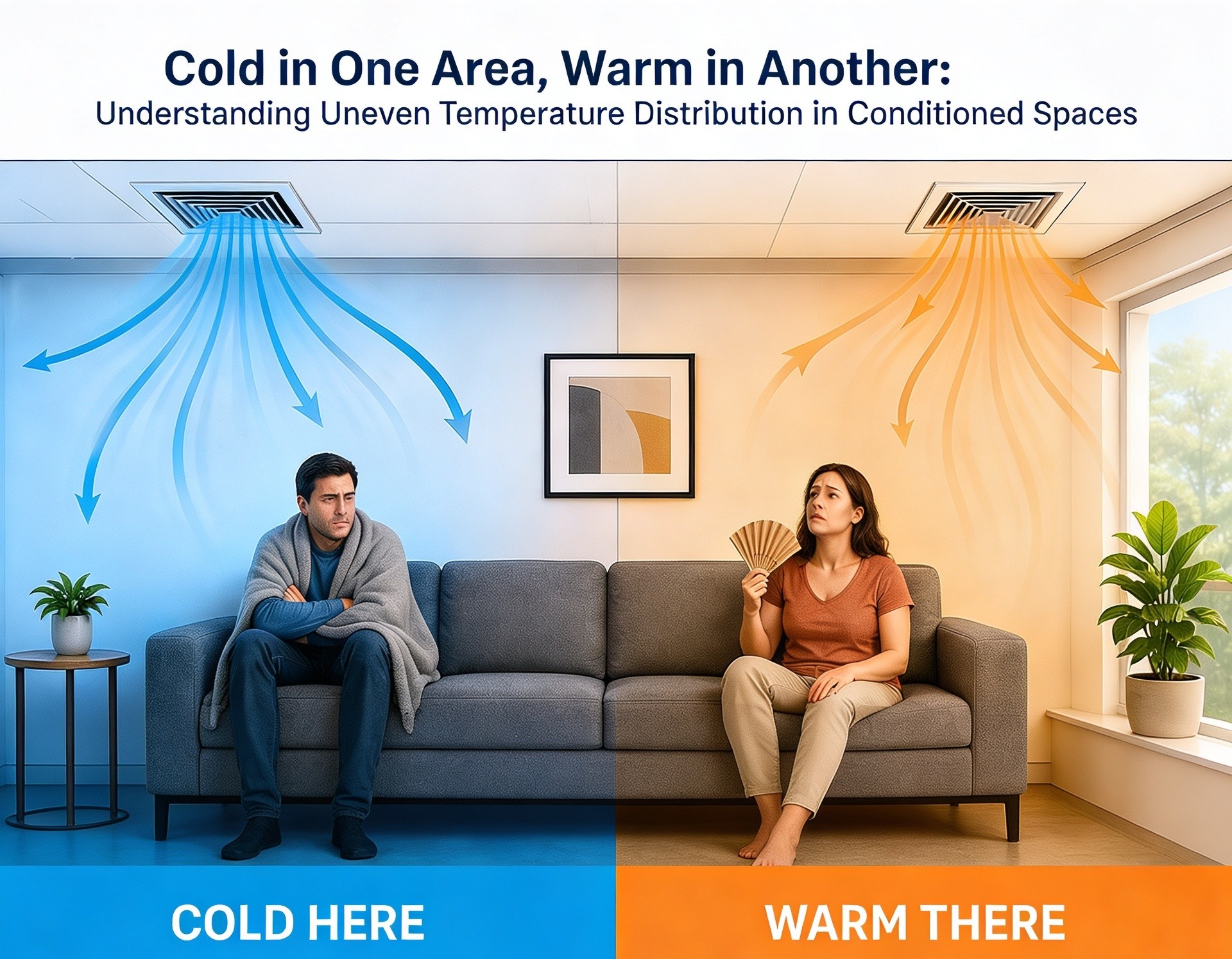
It is a common experience in air conditioned environments. One occupant feels uncomfortably cold, while another, only a few meters away, experiences insufficient cooling. Despite the system operating at a constant setpoint, the indoor thermal conditions remain inconsistent.
This phenomenon is not typically a failure of the air conditioning unit itself, but rather a consequence of ineffective air distribution, system imbalance, and variations in thermal load within the space.
Air Distribution: The Primary Factor
The performance of any HVAC system is heavily dependent on how conditioned air is delivered into the occupied zone. Even when the system supplies air at the correct temperature, poor distribution through diffusers can result in localized overcooling or undercooling.
Improper diffuser selection, incorrect throw patterns, or insufficient coverage often lead to uneven airflow, creating distinct temperature zones within the same room
Air Mixing and Stratification
Effective thermal comfort requires adequate mixing of supply air with room air. When mixing is insufficient, stratification occurs, where cooler air remains concentrated in certain regions while warmer air accumulates elsewhere.
This is particularly evident in spaces with low air velocity or poorly directed airflow, where conditioned air fails to reach all occupied areas.
Supply and Return Air Configuration
The placement and coordination of supply diffusers and return air grilles are critical to achieving balanced airflow patterns. Poorly positioned returns may draw air prematurely from specific areas, preventing proper circulation throughout the room.
As a result, certain zones receive continuous cooling, while others remain largely unaffected.
System Balancing and Commissioning
An often overlooked aspect of HVAC performance is air balancing. Without proper commissioning, airflow rates across diffusers can vary significantly. Dampers that are not correctly adjusted may allow excessive airflow in one branch and restrict it in another.
This imbalance directly contributes to uneven temperature distribution and occupant discomfort.
Variation in Internal Heat Gains
Thermal loads within a space are rarely uniform.
Factors such as:
can vary across different areas of the same room. Without responsive airflow control, the system cannot adequately compensate for these localized variations.
Absence of Zoning and Control Systems
Modern HVAC design uses zoning strategies such as Variable Air Volume (VAV) systems to regulate airflow based on demand. Without these systems, the HVAC system supplies conditioned air uniformly, regardless of differing zone requirements.
This limitation reduces the system’s ability to maintain consistent comfort levels throughout the space.
Implications for Comfort and Efficiency
Uneven temperature distribution not only affects occupant comfort but also impacts overall system efficiency. Overcooling certain areas leads to unnecessary energy consumption, while undercooled zones may prompt users to lower thermostat settings, further increasing load on the system.
Conclusion
The presence of hot and cold spots within the same room is rarely coincidental. It is a clear indication of airflow inefficiency, improper system design, or inadequate commissioning.
Achieving uniform thermal comfort requires a holistic approach, encompassing correct diffuser selection, effective air distribution, proper balancing, and where necessary the integration of zoning controls.
Ultimately, comfort depends not just on the temperature setpoint, but on how precisely the system delivers and controls conditioned air within the space.
Discover more about Maxell Global & Finpower Aircon
© Copyright 2026 Maxell Global All Rights Reserved